Showing posts with label ILC. Show all posts

Thursday, February 19, 2015

Fix a loose lens adapter

Adapting a lens to another camera system generally involves using an adapter of some sort. most of the time, I buy cheap adapters off amazon because for the most part, they do fairly well.

However, I often end up with adapters that are a little loose. This is bad for a couple reasons. The first issue is the adapter if too loose may jiggle a little making focusing manually a bit more difficult, and inaccurate. The second issue is if the lens isn't held in place properly, it can end up at an angle to the sensor, preventing optimal sharpness in the plane you expect.

Lets take a look at a cheap adapter for Nikon G to Canon EF mount.


The adapter is from "Fotasy" which is a cheap chinese company that may simply resell adapters from another company. Here the adapter is attached to the lens first to "convert" the mount of the lens to EF. The fotasy lens adapter is pretty slack. I get better fittings from other brands "fotodiox" for example.


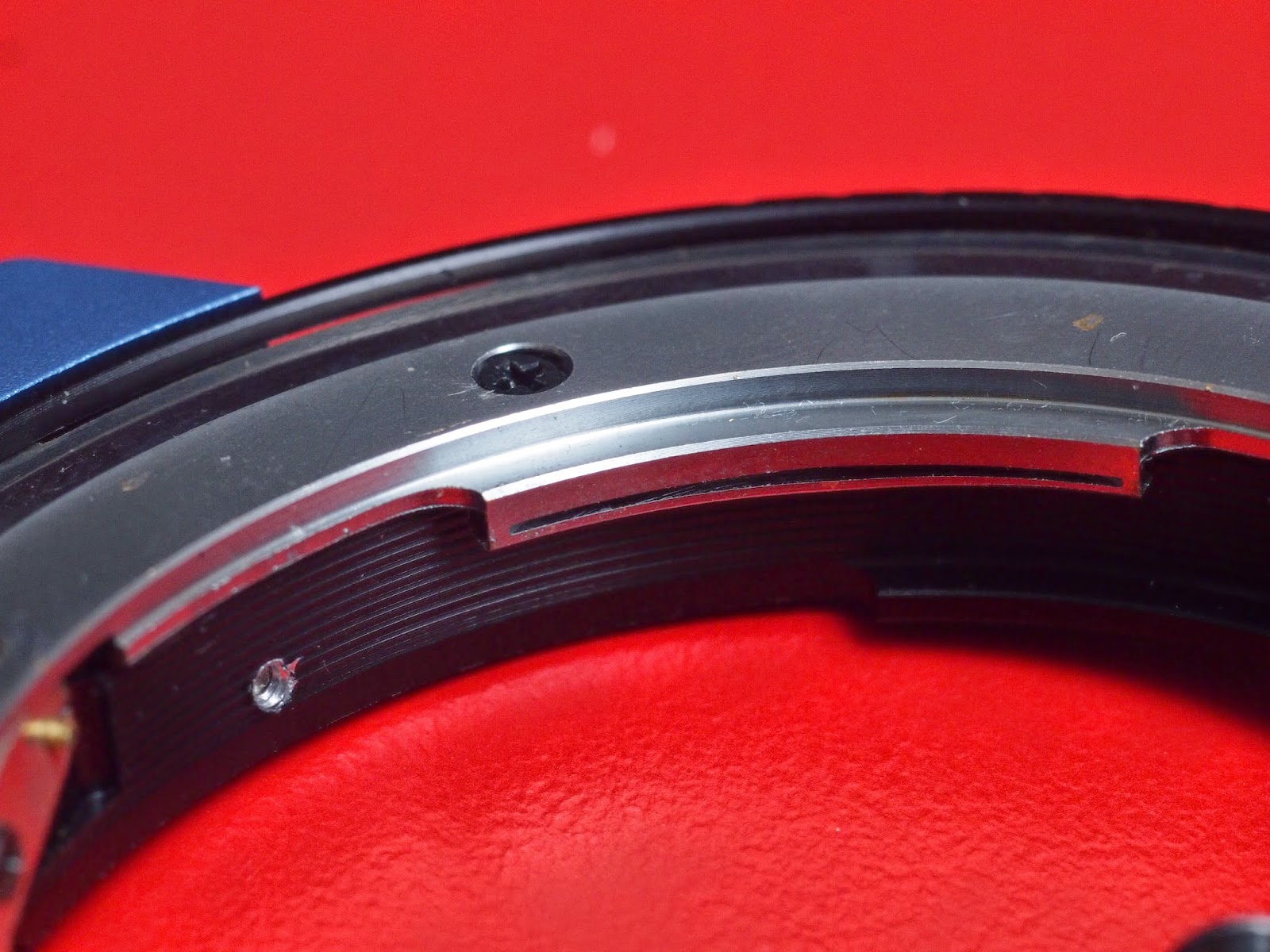
The inner lugs of the adapter that grip the lens has a slit. Take a good look at the space here. This is a closeup of the adapter's lug.
This is meant to act as a "spring" to apply pressure to the camera's mount. This "fotasy" adapter has extremely weak "springs".


My goal is to increase the force of these springs to have a tighter fitting adapter. I use a screw driver and firmly push it in the space. Do it slowly to gently make the gap wider and increase the effect of the spring. 


Wiggle the screwdriver into the slit, expanding it slowly.


Don't make it too large. A little will help a lot.


On the Fotasy, this is a rather weak spring, and it helps a little. Stacking strips of tape or paper, inserting it and trimming it with an Xacto or razor works great to cushion the spring a bit. I used a post-it note to "fix", folding it a few times and squeezing it in, and cutting off the rest.

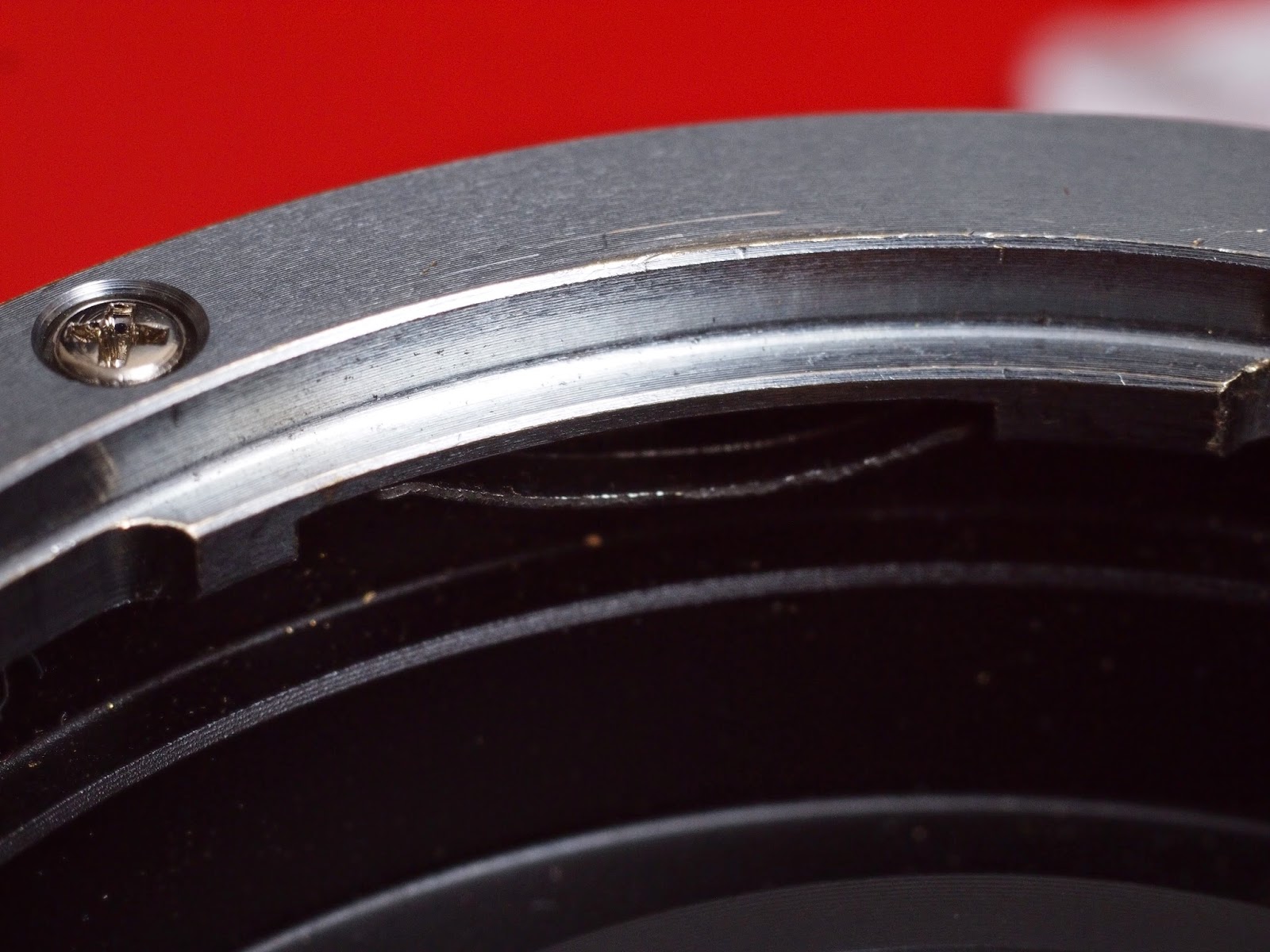
Here's what a pricier adapter looks like:
The spring of a pricier option - this is a Canon EF-MFT adapter, so in addition to costing more, there's also more room for better springs.


Once back on, the adapter holds firmer, having little or no play. Now go out and shoot!

Monday, February 3, 2014

A little test of 4 different 25mm F1.4 lenses on Micro Four Thirds

So, I'm not fond of formally testing lenses myself (though I do like to read em). Comparing a couple lenses may be fairly quick (quick and dirty may not check everything ), but putting four lenses into an easily readable report takes up some time. So I'm not doing this with too much depth. This is just to assert to myself the feel of these different solutions, that share the same 25mm f1.4 specification, and look at more obvious differences in their results.

This is a very different kind of roundup. There's only one lens here I'd expect people to come across "in the wild". The next most common is a C-mount so yes, lets get weird...


The lenses here (on my Olympus EP3) are:
  1. Panasonic (Leica) DG Summilux 25mm F1.4 ASPH.
  2. Pentax TV lens 25mm F1.4 (1" coverage)
  3. Wollensak Cine Raptor 25mm F1.5
  4. Nikon 35mm F2.0 AI Nippon Kogaku
First off, some of these names just simply sound exotic. It brings to mind images of awesomeness that simple named lenses can't match. Obviously, fancy names equal good image quality...
Sarcasm aside, I like these names. It really helps set these aside from just being a mundane amalgam of specifications.


About the lenses:

Summilux is what Leica calls their current batch of lenses with an F1.4 aperture. Leica itself is a luxury brand in cameras. Leica's been at this for a while - their compact landscape camera dates back to 1913. They've got history, and a name that carries weight, so it makes sense that Panasonic would want to ride that name. The lens is Panasonic made but designed or approved by Leica. This is a current production lens for the high grade MFT market.

The most pedestrian of names is the Pentax TV lens. Quality is a bit better than the cheap 25mm c-mounts lenses on ebay that go for $25-$50, but it's not that great. It is quite comfortable to use with it's smooth ring though. This lens still exists, but is now branded Ricoh. This is a current low cost CCTV lens. Stepless aperture is good for video. While Pentax is also steeped in optical history starting with spectacle lenses, a mass production and cheaper lens like this probably inherits little of their mojo.

Wollensak was making camera lenses as far back as 1902,and shutters from 1899. They pushed high speed photography and video with their fastax brand, developing on a Bell Labs spinning prism implementation taking frame rates up to 18,000fps in the 1960s. For their film cameras, they have a line of cine lenses (c-mount)that were good value at the time. The company went under in 1972, so the lens here is at least as old as that.
 

Nikon has been around since 1917, but at the time was known as Nippon Kōgaku Kōgyō Kabushikigaisha (say that ten times fast...). It stayed that way for a long time, but in 1988, someone thought that it was too much of a mouthful, so the company was renamed to Nikon Corporation. "Nikon" dates back to 1946 and was formed from the words "Nippon" and "Ikon". Ikon was a Zeiss brand. In 1959, Nikon started pushing their Nikkor F line of SLR cameras. The 35mm F2.0 in use is an optical design introduced by Nikon in 1962. In 1975 Nikon updated the lens to stop down to F22, and since my lens doesn't have that option, the age is between 1962 and 1975 - possibly closer to 1975 since Nikon initially used chrome noses instead of all black on their lenses.


The Panasonic Leica produces a beautiful rendering. It's sharp to the edge, and the bokeh is smooth. Focus is quick. Manual focus is horrible since the focus ring is electronically connected to the glass and not mechanical. however, this gives it a relatively compact size for this level of quality and speed. It should be noted - this lens would be auto corrected in the camera for certain traits (CA/distortion etc), so the JPGs used would favor this more than other lenses here.
Ye olde Nikon 35mm F2.0 on focal reducer. Slight difference in focal length. Quality is decent, but it's definitely not as sharp. I can't say it's purely the focal reducer or the lens, the fault is probably shared between the two.

That said, it's sharp enough to satisfy most and make a good picture. Bokeh is nice, maybe the nicest of the bunch. it's focused a few millimeters in front of the Panasonic, so blurring is a little different, but as you can see it's quite smooth.

Also of note - the entire image shows little or no light falloff. Even on a full frame camera, this lens was well known to deliver low vignetting.
I loved using this Wollensak lens. Before MFT had a lot of lenses available, people were adapting any fast prime they could find to get a decent F-Stop. Classic manual focus 50mm lenses were common, and cheap, but they were also an equivalent 100mm on this format. The field of view more specific in usage compared to a "normal". C-mount lenses like these 25mm lenses were perfect fits for the system - small, light, and some actually delivered decent quality.

The Wollensak here shows a very sharp center quality - surprisingly sharper than the 35mm F2.0 on focal reducer. while it's not quite F1.4, the F1.5 is close - however it was never meant to cover this large a sensor. Resolution and brightness both fall off at the edges. Heavy vignetting here. It's a decent lens for individual shots giving an artistic effect, but not a good choice for a sharp clear picture.

Looking at the F-keys at the bottom you can somewhat make out the most interesting characteristic of this lens, and it's the way bokeh is rendered. Blurring is somewhat radial about the center of the lens, and produces a unique effect with background lights.

Distortion is pretty bad, but you know what you're getting into with this lens. Again - One of my favorites, but you have to work within the character of the lens.
This Pentax is the cheapest of lenses here - not just in cost really (this was purchased new) but in design, feel, and optical quality. A Modern c-mount. The very tips of the corners have vignetted to almost nothing. Like the Wollensak above, there's distortion, vignetting and it gets worse at the edges but unlike the Wollensak, the center isn't nearly so spectacular, and of course we see a characteristic glow on object edges with this lens used wide open. Cheap lenses like this often exhibit a curving focal plane - i.e. as you move from the center of the lens to the edge, an object may have to move closer or further away from the plane of the lens and sensor to stay in focus.

Of course, the question here is "is this usable?" - again like the Wollensak, there's a lot of "character" i.e. imperfections you need to work with. It can give you a decent picture if you try. The redeeming aspect of it is it's weight, and ease of focusing. the focus moves smoothly and easily between the index finger and thumb.


So that's 4 lenses - 3 different types that are 25mm F1.4. There's no MTF curves or going into technical details here and I'm only looking at them wide open - so this article's usefulness will be rather specific, but I think it's interesting to see them here. As evidenced, everything is a tradeoff. Size, cost, build quality, ease of focus, sharpness, vignetting, chromatic aberrations - even the high end Leica here loses to all 3 in ease of manual focus, and the 35mm easily has it beat for vignetting. Every lens here has something it's better than the others at - even the optically worst lens of the bunch has redeeming qualities. Photographic gear is an exercise in compromise. 

I have a crapload (technical term for a lot) of lenses with overlap. But it doesn't mean I don't have a reason to use them. Sometimes I run with the Wollensak just for fun. Since I'm heavy into manual lenses, it's good to keep practicing focus. The results are different, and can be quite fun when done right - say, taking a photo of someone in front of a Christmas tree and seeing the swirly bokeh transform the background of image into a more atypical picture.


Everyone with an interchangeable lens camera should try a manual focus lens sometime. You may like it - and if you do, you suddenly open up decades of easily adaptable glass, often with wider apertures that you'd normally get as a result of cost - and with a focal reducer, that F-Stop can become even better, while supplying a wider angle of view.


Wollensak 25mm F1.5 - "Some dude on a bike..."
Sharp center makes the bike "pop". Less sharp edges don't matter here, and the distortion is somewhat masked by motion blur.

Monday, December 2, 2013

So you think you want a DSLR...

When you're looking at a picture and think it's an SLR, it's just the effect of a good lens and sensor. It's not necessarily an SLR. It can be a rangefinder, a mirrorless interchangeable lens camera even a large sensor compact.


In this post, I will explain:
  • What makes a DSLR different from simple compacts (size, mirror)
  • Usability differences (viewfinder and specific AF points)
  • CDAF and PDAF focusing methods (CAF, specific points vs full sensor)
  • DSLR Alternatives (MILC/large sensor compact)
  • Large Sensor Compacts (a few options)


I've seen several people say they want a DSLR after viewing another person's pictures. The problem is there are several cameras out there that can give the effect they want, but they only recognize the almighty DSLR as the means to it.

Don't get me wrong - for the most part, a good DSLR is a superior option, but think of the average person using their camera to take a picture of their family. Be it a phone or compact camera, they're not bothering with how they're focusing, ISO, Aperture etc. They're also not taking the picture with their eye up to the camera, as there's most likely no viewfinder.

What makes it a DSLR...
So right off the bat, there's a usability difference. The "R" in DSLR is reflex. It refers to the action of the mirror that the user looks through when taking pictures. 
 
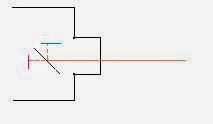
In the above left diagram, the ray of light coming in hits the angled mirror and focuses on the blue line. This line contains the focusing screen, and auto focus sensors. Light passes through here to a prism or mirror then through the viewfinder. The "problem" with this is focusing is done at fixed points (see diagram on the right). Some of these points are more sensitive than others (usually center point) meaning in tough conditions, only those points will focus. This leads to the common act of focusing with the best point(s) -AF sensors at the center- and recomposing the shot.

This type of focusing is called Phase Detect. Now you need to be concerned with which points are active. Otherwise you wont focus on what you're taking a picture of! When the shutter button is pressed, the mirror flips upwards, and light hits the sensor.

NB: credit Anandtech for AF points diagram.

The other aspect is the sensor size - but this isn't exclusive to DSLRs. It's just that no DSLRs use the tiny sensors found in phones and common compact cameras.

What makes simple cameras easier?
There's more work involved in simply focusing with a DSLR. Why? Well to be fair, you can get the similar "problems" with higher end compacts that let you select focus. I'm calling it "problems" because it's really control.
A good compact/phone camera generally autodetects faces removing the need to worry about how to focus. With small sensors, scenic shots generally have so much depth of field it doesn't matter if they're a little off. i.e. most everything is in focus. 

Focusing of these cameras is done directly on the sensor. In phase detect (DSLR), the light from the lens is directed to a focusing screen with AF sensors. The sensors manage focus. In small compacts, phones, and mirrorless interchangeable lens cameras, the focusing is done by the same sensor taking the picture. The advantages are the entire area of the sensor can be used to focus. Think of it as having AF points everywhere, all with the same maximum sensitivity.
Also, since the entire sensor is active, image processing can be used to detect stuff like faces, or smiles, so it can automatically focus on people's faces, and autosnap if they smile.

This type of focusing is called Contrast Detect.

Why use one or the other?
It sounds like Contrast Detect (CDAF) has some advantages over Phase Detect (PDAF) by using the sensor. It does, but that's not the entire story. There's some disadvantages too.

CDAF uses the entire sensor, PDAF is restricted.
CDAF gets the full image, so it can detect faces, objects etc.
CDAF uses the sensor itself where PDAF can have alignment issues and focus a little infront or behind the sensor.

PDAF can determine if an object is infront or behind the current focus plane, and will focus faster generally.
PDAF can perform Continuous Autofocus - i.e. focusing on moving objects for multiple shots currently much better than CDAF.
Using the reflex mirror means there's ZERO latency tracking moving subjects. A CDAF LCD can lag behind the actual movement.

In general, DSLRs will use PDAF. Their CDAF implementations are quite slow. When using a DSLR, you will be restricted to using the viewfinder. The advantage is this actually helps keep camera shake down. the disadvantage is you need to be MUCH more mobile. Especially with little kids.

DSLR alternatives
There are alternatives of course that can give equal image quality to DSLRs, but provide CDAF (there's also rangefinders, but lets not go there...) focusing for ease of use. These cameras are large sensor compacts and mirrorless interchangeable lens cameras.

If you're buying a DSLR but only use the kit lens, get your money back. You're wasting your money. The kit lens is a dark and generally not very sharp lens. The entire point of getting a DSLR or any interchangeable lens camera, is to change the lens to your need.

Mirrorless Interchangeable Lens Cameras (MILC) have the same size image sensor as a DSLR. Micro Four Thirds sensors is slightly smaller, but still comparable in image quality. MILC cameras are smaller - as they don't need the space for the mirror or prism. As a result, there are also less constraints on the lens. i.e. the designer can start putting lenses closer to the sensor.

As with most CDAF based cameras, the rear screen can be used to compose and select focus point(s). This makes it easy to just stand normally when holding the camera at an angle to shoot. Being electronically coupled, these screens can even come on hinges to make it even easier to shoot below, and of course, there are options for regular viewfinders. A camera like the Panasonic GX7 or Olympus OMD-EM5 give both options - a viewfinder and rear viewscreen.

Large sensor compacts do not have a sensor as big as these. Their sensor is small in comparison - however many of them have fast lenses. If you don't want to spend money on lenses, this is probably a better option. The difference between a lens listed as F1.8 and a lens listed as F3.5 is you get 4 times as much light in the same area covered by the lenses. 4 times the light means a faster shutter for less shake, and better freezing of motion. It means lower ISO for less noise - less grainy pictures in low light. It also means more depth of field control, which is subject isolation. Don't expect a lot from compacts though.

My perspective
I've used several cameras, and currently have a Canon 5D and Olympus EP3 as my main cameras. The 5D is full frame, having a much bigger sensor (almost 4x the area).

As far as usability goes, the EP3 wins hands down. CDAF is generally slower - but that's comparing it against the best really - do you have $$$$ for the best?
Focus is lightning quick, and because it can focus an snap the picture based on where I touch the viewscreen, composition is much easier. Taking pictures of my kid running about is much easier.

For quality though, there's no contest. The 5D's pictures take on a whole new meaning to bokeh comparing against the EP3. This is due to the larger sensor really. If I could get the same quality in a mirrorless body, I would no longer have a need for the SLR.

Some solid mirrorless cameras:
  • Olympus - any 16MP cameras (12MP use an older sensor). EPL5, EM5, EM1 etc.
    These cameras are of the Micro Four Thirds standard.
  • Panasonic - their 16MP cameras - again, the older 12MP cameras have an older sensor which is noticeably worse in low light.(G6, GX7, GX1, GM1). These cameras are of the Micro Four Thirds standard.
  • Sony - Sony's NEX system uses APS-C sensors. The same sensor gets used by Nikon and Pentax in their DSLRs and Leica's M8. Lens options include NEX, and sony'd DSLR mount lenses via an adapter.
  • Fuji - The fuji EX series is a capable low light system. AF historically lagged behind NEX and MFT. Lens range is somewhat limited, but they have decent options. Fuji has the right lenses needed to round out your range, but options less than NEX and MFT.
  • Samsung - The NX series uses Samsung's own sensor. It's good, but RAW files are huge, and take a long time to process after shooting. Lens range is limited.
Olympus and Panasonic have clear advantages in lens availability as both are using the same Micro Four Thirds (MFT) advantage. The main lens on my Olympus camera is a Panasonic 25mm f1.4. So not only can you use either brand on any MFT camera, but they've been doing mirrorless the longest, resulting in a much bigger list of available lenses in the mirrorless category.


Some solid large sensor compacts:
  • Panasonic LX7 - excellent low light capability, due to the larger than average sensor (1/1.7") and brightest lens in this category (F1.4-2.3).
  • Olympus XZ-1 - Good low light from 1/1.7" sensor, and F1.8-2.5 lens.
  • Canon powershot G15 - Large compact, but good quality. 1/1.7" sensor and F1.8-2.8 lens. Loads of options, especially with CHDK - canon hack development kit.
  • Sony RX100 - doesn't get much better. 1" sensor and F1.8-4.9 lens great image quality, but this is a pricey option, easily costing as much as a cheap older DSLR + lens.
  • Pentax MX-1 - decent camera, fast lens, large sensor - you get the gist.


So in summary!
  • If you're not going to buy a better lens, go with Large Sensor compact cameras.
  • Looking through a viewfinder to compose shots can be restrictive on movement.
  • Mirrorless cameras use the rear LCD normally to compose and can be quite comfortable to use this way.
  • DSLR advantages over mirrorless are mostly in how they track moving subjects. No lag, AF sensors provide better Continuous AF (usually).
  • Most of what you notice with good pictures is the result of a bigger better sensor and good lens (faster aperture, sharper).


Hope this helps!