Showing posts with label EPL1. Show all posts

Tuesday, May 23, 2023

A bevy of Vintage 50s and focal reducers

This article may not be for you...

Disclaimer about sharpness. The question of sharpness and 50s isn't new. I've seen a lot of photographers knock the idea of pixel peeping, and responses like "Just stop down!" or "Why shoot wide open?" or "Stop chasing sharpness." 

Well, to each their own, but It's still an important aspect of photography to me. I like seeing that critical focus on that part of the subject that I want in focus. Sure, I'm not going to use max aperture on everything - but when I do, I still want a crisp subject in my isolation. 

Why am I using old lenses?

Since the dawn of the camera, gear nerds have always had G.A.S. Gear Acquisition Syndrome. 
It's the insatiable desire for better IQ, more bokeh, faster lenses, longer wider etc.
Over the years I've accumulated a large collection of vintage glass.


I started micro-four-thirds with an E-PL1 and Panasonic Leica 25mm F1.4. I really liked this combination. Micro-four-thirds was new at the time. The problem with any new camera system though - there aren't many lenses for it. I adapted a four-thirds fast zoom, but I really liked primes. The sensor was a bit lackluster at higher ISO. It's not just about sensor size, but also about development. It's 68% the size of Canon's APS-C sensor, but Canon handled high iso a lot better than the size difference suggested.

Then I saw that mirrorless with a low flange distance could adapt lenses. Behold! Cheap fast primes were suddenly available. DSLR lenses, range finder lenses, c-mount...

Mirrorless cameras today are like digital-backs for older lenses. The crop of the micro-four-thirds sensor meant every lens was effectively longer. Were they any good? Sure. Maybe not wide open, some lemons, some degraded with time, some had nice character - some too much! This moon was shot with the $40 Vivitar 400mm with a cheap Vivitar teleconverter. I thought this was spectacular. 


Vintage glass was also a cheap solution for macros.

And vintage glass could be fast! As fast as F1.2 without getting too expensive. My most expensive glass was the Nikon 50mm F1.2 ($375) and Canon FD 55mm F1.2 SSC ($271). Compare this to the Canon EOS 50mm F1.2 L which was $1300 - perhaps $1000 used.

I did want to try a full-frame look with these lenses. I got the Canon FD 55mm F1.2 SSC first. I replaced the FD mount with an EF mount conversion kit. Being successful there, the next part of my plan was to purchase a used Canon 5D classic - but the mirror would hit the back of the lens, so I used a Dremel to grind the mirror. I swapped the focusing screen and wow, cheap full frame 50mm F1.2 for far less than Canon's 50mm F1.2L. My daughter was just a baby now, and I was getting some real keepers.

Manual focus is a different kind of beast - you have to learn tricks on how to focus. I'd practice with my daughter - She'd run and jump and I'd try to prefocus at a point and nail it. Sometimes, I'd focus on the ground where she'd be expected to cross, and as she got to that point, I'd time it and snap.

With the focus screen, and my then younger eyes, I still had a lot of missed focus shots - but they weren't bad. And upon nailing the focus just right, I'd be rewarded with the creamy goodness of that F1.2 f-stop. This is my little angel running towards me. This was shot wide open on the 5D, 1/100, ISO 800. Given that the 5D ISO got noisy above this, I was thankful for the fast lens.


Is this gear "pro" enough to be recommended in place of current gear? LOL NO... Not then, not now. This is an amateur's hobby gear. A fun experiment that occasionally gives astounding results. The 5d was perfect for me - the Canon EF mount was a few millimeters shallower than the Pentax K, M42, Leica R, Nikon, Contax Yashica, and Olympus OM mounts - So I was able to adapt most of my older DSLR glass to this amazing camera. Naturally, I'd be looking up the most common cheap fast lenses of all - 50mm glass. Back then I'd score F1.4 speeds for $30 off eBay or KEH. The price of those jewels has risen quite a bit, as the mirrorless crowd gobbled them up.

At ~2013, Metabones released their focal reducer - branded a "Speed Booster". Focal reducers weren't new - they were used in telescopes mostly but used between a mirrorless camera's sensor and DSLR's lens (designed to be far from the sensor for a mirror), suddenly crop sensor cameras were giving pictures more similar to larger sensors. It wasn't perfect, but the image brightness was noticeable, and the concentration of light did somewhat increase resolution. The result was 50mm, which had a field of view of a 35mm lens. An F1.8 captured light like an F1.3. An F1.4 was like an F1.0. An F1.2 was a blistering effective (theoretically) F0.86.

Clones followed. Focal reducers as I mentioned were used in telescopes before, so finding appropriate glass and fitting them into adapters was the next step for cheaper brands. Metabones sold their adapter for $600. Cheaper brands sold theirs for $70 on ebay. Guess which one I picked up.

I'm still using micro-four-thirds, but my Canon 5D is relegated to nostalgia. A Sony A7 is the current house "darling" delivering the creamy smoothness of a full frame with a resolution that leaves the Canon 5D behind. But... I still love my micro-four-thirds. It's so small... Not just cameras, but lenses, and thus necessary tripods, bags etc. I have so many 50mm lenses - and I jumped on a couple eBay deals to snag an old Metabones "Speed Booster" EF to MFT adapter, and Zhongyi "lens turbo II". Naturally, I had to test these lenses and adapters. Perhaps a lens may favor one or the other. Was the Metabones really that much better? I set up a quick test...


I aimed for the center of the larger chart, and went back enough to get the eye-chart at the edge.

What am I testing

There are 3 main speed boosters you can get today. Probably more - "Commlite" comes to mind, but it's likely they're using an existing lens design. Here are the speed boosters I have. Zhongyi Lens Turbo II, Metabones EF-M43 "smart" adapter (aperture control), and the Pixco "generic" speed booster. Do note that the "smart" feature of the Metabones Speed Booster works against adapted old lenses, shorting out the pins. I disabled my speed booster. All focal reducers here are EF mount - because so many other lens mounts work on EF.


Here's a look at the lenses I tested. I should probably weigh them. The Nikon 50mm F1.4 and Contax are the lightest here. The Canon 55mm F1.2 could possibly be weaponized against zombies.


A look at center sharpness


I'm not going to say which is best. Some of these are close enough to be subjective. You can see and judge what you like. 

Some notes though.
  • Minolta is off by itself since it cannot mount to Canon EF. That lens has its own Pixco adapter.
  • The Cheap $70 Pixco has nicer contrast and sharpness than the Zhongyi, although the Zhongyi lens turbo II is a little brighter. I'd recommend the Pixco based on that though.
  • Viltrox provides aperture control and autofocus. The image though is smeary Vaseline. 
  • All shots were done with a flash to keep exposure mostly constant. ISO 200, 1/160 shutter speed, and lenses were used wide open.
  • I think the Nikon 50mm F1.4 is quite good, being the "newest" of the vintage class. It's almost as bright as the 1.2s but has better contrast wide open. The Minolta is cheaper to obtain but not quite as sharp. 
  • The sharpest lens wide open is the Rokinon 50mm F1.4. The Zeiss is beautifully sharp too and the Takumar is spectacular given its age, but the Rokinon has truly impressed me here.
  • The SMC Takumar 50mm F1.4 yellowed with age. That's radioactive glass! It's beautiful and crisp - but darker than the F1.7 Zeiss Planar. I left it in the sun, with some foil under it to "cure" the yellowing (UV light). It did lighten up a lot before this test. I left it there for maybe 2 weeks. I think the dark effect of the glass diminishes the benefits of this fast lens.
  • The Canon 55mm F1.2 and Nikon 50mm F1.2 seem close. I snapped the tabs off the Nikon lenses so that I could use them on all the focal reducers. The Canon 55mm F1.2 SSC is spectacular on the Metabones adapter and is ahead of the Nikon 50mm F1.2 there. Strangely enough, I think the Nikon F1.2 does better on the Pixco adapter than the Canon. I've gone back and tried this several times. It really does seem that an adapter can work better with some lenses than others.
  • The Nikon 50mm F1.4 on Pixco looks really good - spectacular given the price.
  • The Rokinon has me absolutely floored. I really wasn't expecting it to blow me away. Online reviews generally paint it as "average". Not a bad lens - but in competition with modern brand specific 50mm F1.4s, it does not really stand out - while at the same time, lacking autofocus. Getting this used at a fraction of the cost ($334 from their site, <$200 used) provides a magnificent manual lens for use on a focal reducer.

What about the Edges?

NOTE: pending redo!

  • The Nikons seem to have the edge here on the Pixco and Zhongyi LensTurbo II, though the LensTurbo falls apart at the edges.
  • The Nikon 50mm F1.4 continues to impress on the cheap Pixco adapter. A good combination of contrast and clarity.
  • The biggest disappointment is the "modern" Canon 50mm F1.4 USM. That current lens just can't keep up with the Nikons.
  • The Zhongyi just isn't as nice a render as the Pixco. Given that the Pixco is a half to a third the price new, it just seems like a better buy.
  • Neither cheaper adapter can do the Canon 55mm F1.2 justice. The Metabones Speed Booster clearly shows superior contrast and brightness. 
  • I'm not investing in Canon EF gear, and the Canon 50mm F1.4 USM sucks using manual focus. Wide open it falls to the older Canon 55mm F1.2 SSC. Given that, and the fact that my Panasonic G9 would error out with vintage glass attached shorting the Metabones "smart" adapter pins, I disabled it. I opened the Metabones and cut the ribbon cable. Now there are no more errors and problems with vintage glass.
  • I'd say the Metabones Speed Booster is worth it if you still like vintage lenses and want the most out of them. Just use eBay and hunt. I'd be very satisfied with the Pixco-generic if the only available Metabones Speed Booster was $600 (current cost).
  • I might try cutting the protrusion off the Nikon lenses so that I can run them on the Metabones and see how they perform there.

Other aspects of the lenses are also relevant!

  • A lens could be sharp, but also difficult to focus. I don't think the Modern Canon 50mm F1.4 USM is bad. But it's not great, and manually focusing it is compounded by the sticky, rough focus action.
  • Focus action on the Canon 55mm F1.2 is butter smooth, and long. It's easier to move past focus and move back to where you saw focus peak. the Takumar is also great for this. It's a pleasure to use. the Contax Yashica Zeiss is also nice. Not as smooth and damped, but still a pleasure to use. 
  • The Nikon focus action isn't nearly so nice and damped. It's not nearly as rough as the modern Canon 50 USM, but I'm surprised it's not smoother.
  • The Canon 55mm F1.2 SSC is an FD mount. This predates EF and is not adaptable. I found a mount replacement (EdMika) that replaced the FD bayonet mount with a brass EF mount. This makes this a one-of-a-kind lens.
  • The Nikon 50mm F1.4 can go from $75-$100 on eBay. The Pixco adapter is ~$70. You can end up with a $160 35mm F1.0 with this combination. An impressively low price for the speed and quality.
  • The Rokinon is a beautifully made lens - but it's large. It's larger than the Canon 55mm F1.2 FD, and the Canon 50mm F1.2 USM. The focus is nice and damped, with just the right length of throw. It's not metal, but decent-quality plastic. If this were metal, I doubt it would be affordable.

How they look on M43 cameras

The Panasonic G9 is my current "main". In this picture, the Metabones + Canon 55mm F1.2 is mounted to it. The Olympus E-M10 II is my backup. I've put the Nikon 50mm F1.4 and Pixco adapter on that one.


Here we can see my current favorite - The Rokinon+Metabones on the G9. An old GX1 wth the Pixco+Zeiss 50mm F1.7, and an ancient E-P3 with the Pixco+Minolta 50 F1.4.


Todo:

  • Attempt to put the Nikon lenses on the Metabones adapter - it deserves a try 😁
  • Go out and have fun with the Canon 55mm F1.2/Speed Booster. 👍
  • update: Nikons tested! Broke tabs off with pliers. Pretty sharp, but lacks contrast on Metabones wide open. Have to update the images.
  • Have to test bokeh smoothness and flare. That may be interesting ;)


Thursday, February 19, 2015

Fix a loose lens adapter

Adapting a lens to another camera system generally involves using an adapter of some sort. most of the time, I buy cheap adapters off amazon because for the most part, they do fairly well.

However, I often end up with adapters that are a little loose. This is bad for a couple reasons. The first issue is the adapter if too loose may jiggle a little making focusing manually a bit more difficult, and inaccurate. The second issue is if the lens isn't held in place properly, it can end up at an angle to the sensor, preventing optimal sharpness in the plane you expect.

Lets take a look at a cheap adapter for Nikon G to Canon EF mount.


The adapter is from "Fotasy" which is a cheap chinese company that may simply resell adapters from another company. Here the adapter is attached to the lens first to "convert" the mount of the lens to EF. The fotasy lens adapter is pretty slack. I get better fittings from other brands "fotodiox" for example.


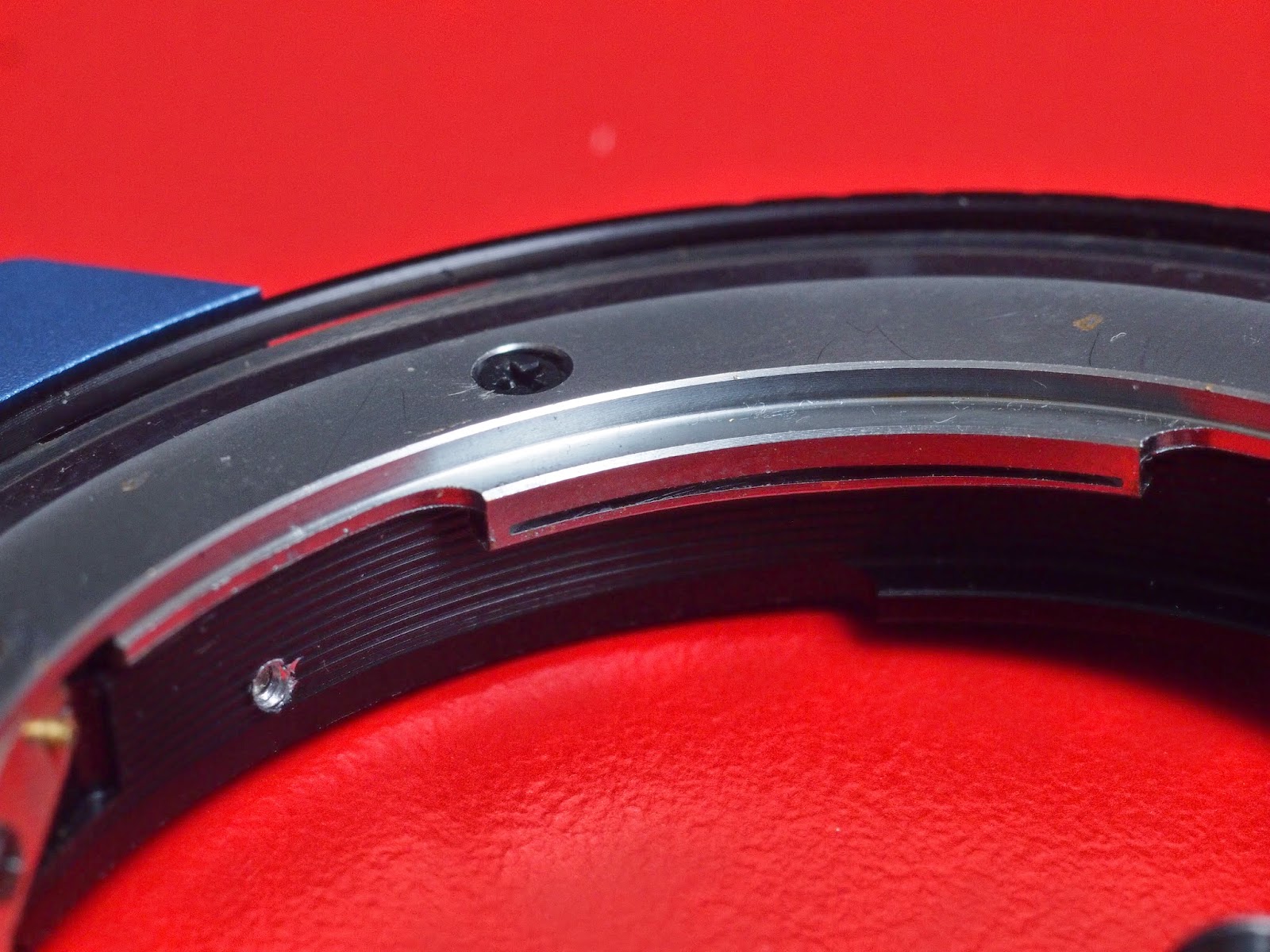
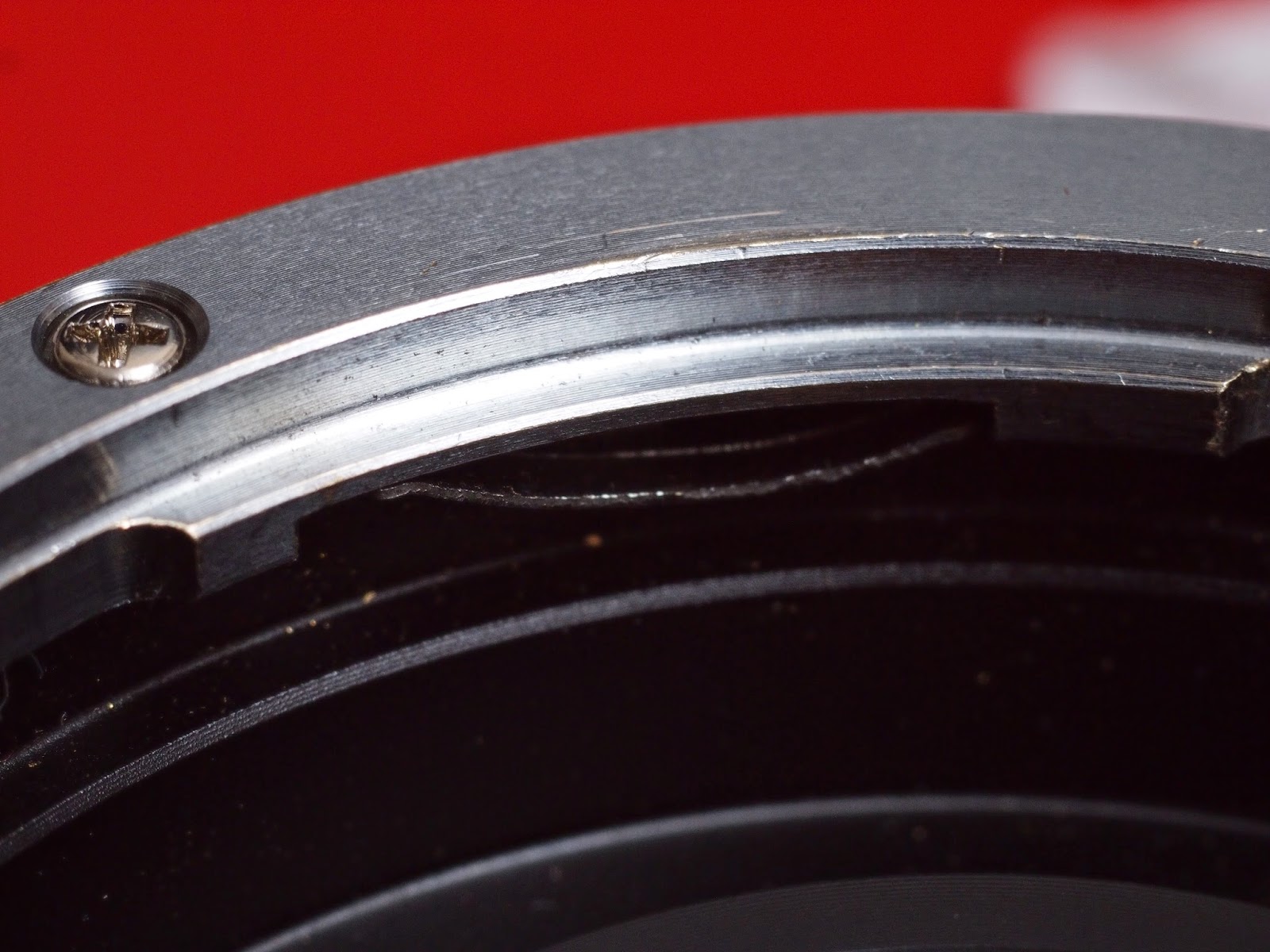
The inner lugs of the adapter that grip the lens has a slit. Take a good look at the space here. This is a closeup of the adapter's lug.
This is meant to act as a "spring" to apply pressure to the camera's mount. This "fotasy" adapter has extremely weak "springs".


My goal is to increase the force of these springs to have a tighter fitting adapter. I use a screw driver and firmly push it in the space. Do it slowly to gently make the gap wider and increase the effect of the spring. 


Wiggle the screwdriver into the slit, expanding it slowly.


Don't make it too large. A little will help a lot.


On the Fotasy, this is a rather weak spring, and it helps a little. Stacking strips of tape or paper, inserting it and trimming it with an Xacto or razor works great to cushion the spring a bit. I used a post-it note to "fix", folding it a few times and squeezing it in, and cutting off the rest.

Here's what a pricier adapter looks like:
The spring of a pricier option - this is a Canon EF-MFT adapter, so in addition to costing more, there's also more room for better springs.


Once back on, the adapter holds firmer, having little or no play. Now go out and shoot!

Sunday, February 8, 2015

C-Mount lenses on MFT (micro four thirds)

Micro Four Thirds was unique among interchangeable lens cameras when it was introduced. It was smaller than DSLRs, yet had a decent sized sensor - the same size as Olympus and Panasonic DSLRs at the time. Almost 70% the area of a Canon APS-C sensor it was capable of delivering very decent quality. What made it really unique was the very short "flange distance" made possible by not using a mirror as is "normal" in an SLR.

The flange distance is the distance from the sensor to the lens mount surface of the camera. Nikon F-Mount DSLRs for example have a flange distance of 46.5mm. Lenses where the rear element gets beyond this point risk being smashed by the mirror when taking a picture. Remember in a DSLR, that mirror is directing light upwards to the viewfinder, and when you press the shutter, it will swing upwards.

Micro Four Thirds uses a 19.25mm flange distance. This means that if A Nikon F-mount lens were held 27.25mm away from the Micro Four Thirds camera's mount over the sensor, it would be able to focus properly on the sensor, since it's the same distance it would be in a regular Nikon F-Mount camera.

In a case like this, adapters are made to let users mount the lens onto their Micro Four thirds cameras. Normally they are manual only, as no electric signals will get from the lens to the camera. This is fine though, as old lenses usually have the wonderful feature of an aperture ring. It's just like aperture priority in regular use, except now your aperture control is a direct mechanical link. Sounds better actually :)


C-Mount lenses refer to a range of lenses used on CCTV security cameras, 16mm movie cameras, machine vision and robotic applications etc. The problem with assessing one of these to determine if it will work on a MFT camera properly is the image circle of C-Mount is not standard. The Sensor for These can range from 8mm (also listed as 1/3") to 25mm (1"). A 1" format lens is generally more expensive, but is more likely to cover the MFT sensor. Some 2/3" format lenses can work, but generally result in vignetting, and poor quality edge/corner images.


C-Mounts are fun because they're generally tiny. After all - if you have a 25mm adapted DSLR lens, it's fairly hefty on a small MFT camera. Drop in a C-mount 25mm F1.4 and it's still tiny! Go cheap of course, and the quality wont match the DSLR lens. Indeed, most C-Mount lenses result in a picture far from perfect - however, they are cheap, fast can be capable of good center clarity, and can give off a unique swirling bokeh that when utilized is hard to match.


The Lenses:


A smattering of c-mount lenses. Clockwise from top left: General Electric 25mm F1.4, Canon PHF 35mm F1.2, Cosmicar 75mm F1.4, Wollensak 25mm F1.5, Pentax 25mm F1.4.


One of my favorites. A Wollensak 25mm F1.5. Before fast lenses were common on Micro Four Thirds, these small 25mm lenses were quite popular. This originally was meant for old film video cameras. Some vignetting, but recoverable. Lovely render!


This lens looks rather interesting, but vignettes too much at the corners. A General Electric 25mm F1.4 TV lens. Much cheaper than the Wollensak, and the image quality showed it too.


Pentax 25mm F1.4. If one were looking for better quality than the cheap c-mounts from china, this was the one to get. For about $100, this gave a more neutral picture compared to the Wollensak. Other than the extreme corners, there is less vignetting, color was more neutral, though it wasn't quite as sharp. Still a decent lens, and extremely smooth focus action.


The Cosmicar 75mm F1.4. Cosmicar was a Pentax division. I'm not sure if it was a purchase by Pentax, or if it originated from them, but Pentax is now Ricoh. Pentax was merged into Hoya and Ricoh purchased the imaging division.


Another angle showing the nice large front element. While it's large, it's not bad to handle.


This is the Canon PHF 35mm F1.2. It required heavy modding to fit on here. When I work this hard on something I generally like it more than I should. That said, I can't help but love how sharp this lens gets in the center. Face shots of my daughter are wonderful with this, and the focus plane curves forwards towards the edges - this curve makes facial features go out of focus FAST - not optimal, but it if you're wanting to blur, this will satisfy.


The adapter itself is little more than a MFT mount, on a flat washer like bit of metal, with a threaded inset. There are several makes and models available. If you're after a nice thin one to maximize adapting lenses, consider the pictures below.


Sample images:

Christmas tree light bokeh! This was shot with the canon PHF 35mm at F1.2. note the shape of the bokeh circles as the lights are positioned towards the edges and corners of the frame.


Here's a few samples from the above lenses:


The 75mm F1.4 Cosmicar delivers enough coverage and sharpness to pass mustard. While it starts off bright and decent enough at that aperture, stopping down doesn't aid it that much. That said, the bokeh is superb giving a smooth render.


The 25mm F1.5 Wollensak shows a heavier vignette that one would be used to  with standard commercial lenses. It's decently sharp in the center and resists veiling and ghosting enough to be used as an everyday lens. Size as pictured above also helps that designation. Being easy to carry has it's perks! If the best camera is the one you have with you, then being able the carry a good camera means a lot too.


Shot with the Canon PHF 35mm at F1.2 You can see the difference compared to the above Wollensak. The bokeh certainly stands out more - though in comparison to the 75mm, it's not quite as smooth. Note also the curvature of the keyboard, and the heavy vignette. This lens is extraordinarily sharp in the center wide open, yet fails miserably in the corners. This actually makes the lens quite capable of adding focus to a picture. Viewers eyes will be attracted to the sharp center. This can add an artistic element to face shots, and the curvature and character of the render does nicely with lights in dark shots.


The best place to get C-mount lenses imo is ebay.com. While the Pentax 25mm F1.4 was sold up until recently, it was discontinued. Lenses like the Wollensak have shot up in price to astounding levels due to their rarity. I think most legacy lenses would only have their value rise over time as better mirrorless cameras with better manual focus functions (like focus peaking) become available.


For more information on c-mount (cine) lenses, there is the cine-lenses sub-forum at mflenses.com with numerous threads of information and the c-mount on M4/3 group on facebook is quite lively.

Monday, February 3, 2014

A little test of 4 different 25mm F1.4 lenses on Micro Four Thirds

So, I'm not fond of formally testing lenses myself (though I do like to read em). Comparing a couple lenses may be fairly quick (quick and dirty may not check everything ☺), but putting four lenses into an easily readable report takes up some time. So I'm not doing this with too much depth. This is just to assert to myself the feel of these different solutions, that share the same 25mm f1.4 specification, and look at more obvious differences in their results.

This is a very different kind of roundup. There's only one lens here I'd expect people to come across "in the wild". The next most common is a C-mount so yes, lets get weird...


The lenses here (on my Olympus EP3) are:
  1. Panasonic (Leica) DG Summilux 25mm F1.4 ASPH.
  2. Pentax TV lens 25mm F1.4 (1" coverage)
  3. Wollensak Cine Raptor 25mm F1.5
  4. Nikon 35mm F2.0 AI Nippon Kogaku
First off, some of these names just simply sound exotic. It brings to mind images of awesomeness that simple named lenses can't match. Obviously, fancy names equal good image quality...
Sarcasm aside, I like these names. It really helps set these aside from just being a mundane amalgam of specifications.


About the lenses:

Summilux is what Leica calls their current batch of lenses with an F1.4 aperture. Leica itself is a luxury brand in cameras. Leica's been at this for a while - their compact landscape camera dates back to 1913. They've got history, and a name that carries weight, so it makes sense that Panasonic would want to ride that name. The lens is Panasonic made but designed or approved by Leica. This is a current production lens for the high grade MFT market.

The most pedestrian of names is the Pentax TV lens. Quality is a bit better than the cheap 25mm c-mounts lenses on ebay that go for $25-$50, but it's not that great. It is quite comfortable to use with it's smooth ring though. This lens still exists, but is now branded Ricoh. This is a current low cost CCTV lens. Stepless aperture is good for video. While Pentax is also steeped in optical history starting with spectacle lenses, a mass production and cheaper lens like this probably inherits little of their mojo.

Wollensak was making camera lenses as far back as 1902,and shutters from 1899. They pushed high speed photography and video with their fastax brand, developing on a Bell Labs spinning prism implementation taking frame rates up to 18,000fps in the 1960s. For their film cameras, they have a line of cine lenses (c-mount)that were good value at the time. The company went under in 1972, so the lens here is at least as old as that.
 

Nikon has been around since 1917, but at the time was known as Nippon Kōgaku Kōgyō Kabushikigaisha (say that ten times fast...). It stayed that way for a long time, but in 1988, someone thought that it was too much of a mouthful, so the company was renamed to Nikon Corporation. "Nikon" dates back to 1946 and was formed from the words "Nippon" and "Ikon". Ikon was a Zeiss brand. In 1959, Nikon started pushing their Nikkor F line of SLR cameras. The 35mm F2.0 in use is an optical design introduced by Nikon in 1962. In 1975 Nikon updated the lens to stop down to F22, and since my lens doesn't have that option, the age is between 1962 and 1975 - possibly closer to 1975 since Nikon initially used chrome noses instead of all black on their lenses.


The Panasonic Leica produces a beautiful rendering. It's sharp to the edge, and the bokeh is smooth. Focus is quick. Manual focus is horrible since the focus ring is electronically connected to the glass and not mechanical. however, this gives it a relatively compact size for this level of quality and speed. It should be noted - this lens would be auto corrected in the camera for certain traits (CA/distortion etc), so the JPGs used would favor this more than other lenses here.
Ye olde Nikon 35mm F2.0 on focal reducer. Slight difference in focal length. Quality is decent, but it's definitely not as sharp. I can't say it's purely the focal reducer or the lens, the fault is probably shared between the two.

That said, it's sharp enough to satisfy most and make a good picture. Bokeh is nice, maybe the nicest of the bunch. it's focused a few millimeters in front of the Panasonic, so blurring is a little different, but as you can see it's quite smooth.

Also of note - the entire image shows little or no light falloff. Even on a full frame camera, this lens was well known to deliver low vignetting.
I loved using this Wollensak lens. Before MFT had a lot of lenses available, people were adapting any fast prime they could find to get a decent F-Stop. Classic manual focus 50mm lenses were common, and cheap, but they were also an equivalent 100mm on this format. The field of view more specific in usage compared to a "normal". C-mount lenses like these 25mm lenses were perfect fits for the system - small, light, and some actually delivered decent quality.

The Wollensak here shows a very sharp center quality - surprisingly sharper than the 35mm F2.0 on focal reducer. while it's not quite F1.4, the F1.5 is close - however it was never meant to cover this large a sensor. Resolution and brightness both fall off at the edges. Heavy vignetting here. It's a decent lens for individual shots giving an artistic effect, but not a good choice for a sharp clear picture.

Looking at the F-keys at the bottom you can somewhat make out the most interesting characteristic of this lens, and it's the way bokeh is rendered. Blurring is somewhat radial about the center of the lens, and produces a unique effect with background lights.

Distortion is pretty bad, but you know what you're getting into with this lens. Again - One of my favorites, but you have to work within the character of the lens.
This Pentax is the cheapest of lenses here - not just in cost really (this was purchased new) but in design, feel, and optical quality. A Modern c-mount. The very tips of the corners have vignetted to almost nothing. Like the Wollensak above, there's distortion, vignetting and it gets worse at the edges but unlike the Wollensak, the center isn't nearly so spectacular, and of course we see a characteristic glow on object edges with this lens used wide open. Cheap lenses like this often exhibit a curving focal plane - i.e. as you move from the center of the lens to the edge, an object may have to move closer or further away from the plane of the lens and sensor to stay in focus.

Of course, the question here is "is this usable?" - again like the Wollensak, there's a lot of "character" i.e. imperfections you need to work with. It can give you a decent picture if you try. The redeeming aspect of it is it's weight, and ease of focusing. the focus moves smoothly and easily between the index finger and thumb.


So that's 4 lenses - 3 different types that are 25mm F1.4. There's no MTF curves or going into technical details here and I'm only looking at them wide open - so this article's usefulness will be rather specific, but I think it's interesting to see them here. As evidenced, everything is a tradeoff. Size, cost, build quality, ease of focus, sharpness, vignetting, chromatic aberrations - even the high end Leica here loses to all 3 in ease of manual focus, and the 35mm easily has it beat for vignetting. Every lens here has something it's better than the others at - even the optically worst lens of the bunch has redeeming qualities. Photographic gear is an exercise in compromise. 

I have a crapload (technical term for a lot) of lenses with overlap. But it doesn't mean I don't have a reason to use them. Sometimes I run with the Wollensak just for fun. Since I'm heavy into manual lenses, it's good to keep practicing focus. The results are different, and can be quite fun when done right - say, taking a photo of someone in front of a Christmas tree and seeing the swirly bokeh transform the background of image into a more atypical picture.


Everyone with an interchangeable lens camera should try a manual focus lens sometime. You may like it - and if you do, you suddenly open up decades of easily adaptable glass, often with wider apertures that you'd normally get as a result of cost - and with a focal reducer, that F-Stop can become even better, while supplying a wider angle of view.


Wollensak 25mm F1.5 - "Some dude on a bike..."
Sharp center makes the bike "pop". Less sharp edges don't matter here, and the distortion is somewhat masked by motion blur.

Wednesday, January 29, 2014

Focal Reducers with DSLR lenses and light gain math...

A focal reducer is a set of lenses that essentially concentrate the rays of light coming from the back of a lens, into a smaller area.

Metabones commercialize it for adapting SLR lenses to mirrorless, but didn't invent the focal reducer. Astronomers have been using them for quite some time, and Enterprising DIY users were toying with them and SLR lenses/cameras as well.


A lens is circular, and will produce a circular image (usually - funny baffles and built in hoods not withstanding) - hence it is "creatively" called the "image circle". The focal reducer will make the size of this circle smaller (while keeping minimum and maximum focus distance constant).

In making the circle smaller, it packs rays of light more tightly together. The effect of this is it will make the image brighter, and can actually increase the MTF (think sharpness of details) of the lens on that camera.

The other effect is since the image circle is smaller, parts of the image circle (if it was large enough) would come into view, making the lens appear wider.

There's 2 ways to think about it. You can think of it as a wider, faster lens. Or you can think of it as making your camera sensor larger. The camera will see the lens and focal reducer as ONE UNIT. Both of them together is just a lens to the camera. If we look at a focal reducer on the camera from the lens' perspective, light rays just see a bigger sensor. This is also evident if you just look down at the camera. Here's a picture to explain that:
The lines are to show dimension. you can try counting pixels if you really want. you'll find x/x' and y/y' both roughly equal 0.72


For example - my 55mm F1.2
I'm using a focal reducer on my Micro Four Thirds camera, of 0.72x

The crop factor is 2 (1/4 the area)
The equivalent angle of view compared to full frame is 110mm.
The equivalent depth of field compared to full frame is 110mm @ F2.4
Light gathering stays F1.2 - but smaller sensors  are getting less light, so raising ISO (sensitivity) generally introduces noise much faster.

You'll see tons of arguments one way or the other. These are just numbers. They're neither good nor bad. Crop sensors (sensors smaller than fullframe) exist for a reason.

Anyway, so my 55mm F1.2, effective looks like a 110mm F2.4 on a MFT camera (but light gathering stays F1.2).
Putting on a focal reducer (0.72x) my 55mm F1.2, becomes a (55 x 0.72)mm F(1.2 x 0.72) lens - i.e. 39.6mm F0.864!
With and without the focal reducer - think of it as changing the lens to something wider and faster! This was a cheap generic chinese adapter selling for $100 on ebay.
So, what's the effective lens parameters now? 39.6mm F0.864 on a crop factor of 2 becomes 79.2mm F1.728. A pretty decent portrait lens. Again, light gathering stays with the lens - F0.864, so this makes smaller sensor cameras highly capable in low light.

The other way to think about a focal reducer is it makes the sensor effectively larger from the perspective of the lens. Lets do the math.
My crop factor 2 becomes a crop of 2 x 0.72 or 1.44. That's even bigger than APS-C sensors.
Assuming the crop of 1.44, the calculations are applied to each lens used - (55 x 1.44)mm F(1.2 x 1.44) = 79.2mm F1.728.

Light concentration gain? Still have to consider sensor original size or the focal reducer strength here F(1.2 x 0.72) or use the effective aperture and divide by original crop factor = F1.728/2 = F0.864.

I've expressed light gain in terms of aperture. Here's the math to understand what that means in terms of actual light.
change in light = (old F-Stop/new F-Stop)² - I'll explain later

So the F0.864 light gathering compared to F1.2 is (F1.2/F0.864)² = 1.93 times brighter. In other words, we're a stop brighter - effective ISO is doubled.

An alternate way to calculate would be direct from the focal reducer parameter of 0.72x. (1/0.72)² = 1.93.

Finally, here's the math to understand "change in light = (old F-Stop/new F-Stop)²"

lets say we're using a lens of focal length 100
the aperture is a particular size say, 50mm, so our F-stop is F2.

Light coming in is proportional to the area of the aperture. 
Area = πr²
since we're working with diameter and diameter is 2x radius:

Area = (1/4)πd²
light concentration is proportional to aperture area, therefore:
Concentration = k(1/4)πd²
Since k is arbitrary, let's wrap up pi and 1/4 into a general constant:
Concentration = jd²
F-Stop = Focal length[L]/aperture[d]
so...
d=L/F
Now lets relate light concentration with F-Stop

Concentration = j(L/F)²
Since L is a constant for a given prime, let's wrap that into the other constant.
Light concentration = k/(F²)
i.e the amount of light is inversely proportional to the square of the F-Stop.
Comparing new and old F-stops:
to show concentration gain = (old F-Stop/new F-Stop)²

Light concentration new = k/(F'²)
Light concentration old = k/(F²) 
The amount of light I'm getting compared to before is
Light concentration new / Light concentration old
i.e. 
[k/(F'²)] / [k/(F²)] = F²/F'²
Where F is old F-Stop and F' is new F-Stop.

Basically, one f-stop is twice as bright as another, if it's 0.707 the value of the other (1/√2).

FUN RIGHT!!!!!


The 55mm F1.2 on my EP3 using a cheap chinese focal reducer 


 Generally F1.0 and faster lenses cost an arm and a leg for the first installment. This adapter gives me an effective ultrafast lens adding only $100 (adapter cost). The Canon SSC FD 1.2 is about $350 (usually less) on ebay. A brass mount replacement to EF is about $130, so about $580 for a ~40mm F0.85. Very useful for getting less depth of field at a comfortable angle of view, and of course doubling light gain. Cheaper to go Nikon here normally.

Another use is taking good APS-C lenses, and making them incredibly wide on Micro Four Thirds - e.g. the 11-16mm Tokina, will be reduced to ~8-11.5mm, giving a 16mm equivalent wide end. Sigma's 8-16mm would become an astonishing 11.5mm. Of course this would only work well if the lenses are capable of manually being focused. Aperture works with manual lenses since they're designed with the aperture ring.

I'll be playing around with this in the future, but so far, I'm surprised with the optical quality. I don't think details are diminished at all, and I've not yet seen bad flare. Sharpness of this combo is good, but doesn't compare with the 25mm F1.4 Leica that was designed for MFT from the start. It does however make it look like a dark lens by comparison, which is an amazing accomplishment.